How to Stop Tilting Mid-Game (When You Can’t Take a Break)
The match is still live. You’re still replaying the last mistake. Here’s what to do before it starts choosing your next play.

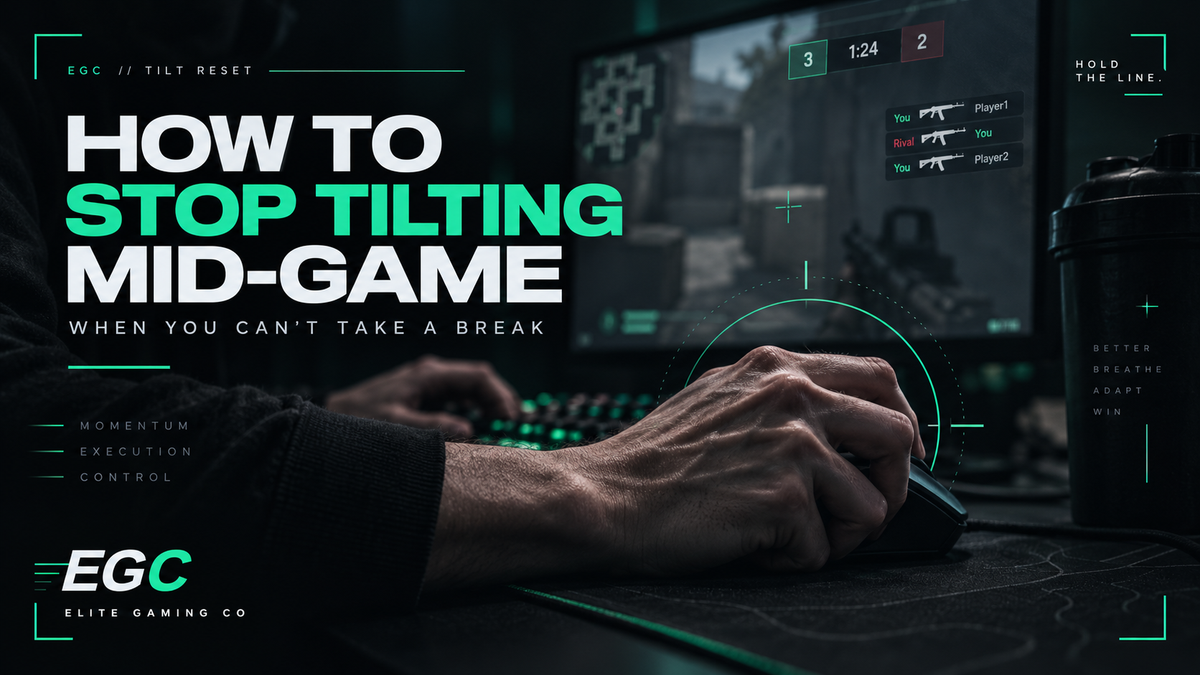
You missed a shot you normally hit. You take a loss you know you shouldn't have and you are pissed. This leads you into the queue and the next round fired up, wanting to redeem the loss or the mistakes you made in the match prior. You may already know that the state you are in is likely not going to lead to any rank climbing or improvement.
You know the typical advice: take a break.
Sometimes that is the right call. It is less useful when the match is still live and your team still needs you. And the main goal in this scenario is for you to stop the last mistake from destroying the next play.
What to do when you start tilting mid-game
This article is going to help you understand what to do when you start tilting mid-game and give you some practical ways to recover.
Here is where you should start: At the next safe pause, check your grip and release any unnecessary tension. Cut the conversation in comms that is pulling you away from the match. And make your focus on your next decision to be clear—not waiting to feel calm—as your first check that you are getting back into the game.
This is a simple sequence to start with to bring your attention back to what matters in the current match. Keep your attention on live play.
Why one bad play can become more than one mistake
Consider the difference between these two thoughts:
I took that fight knowing it wasn't going to end well.
I knew that guy would be a head peeker or camping that spot, I hate guys like that. Now I have to do extra to turn this around.
The first is evidence of less tilt and gives you something to work with. You could logically see what went wrong and knew where you fell short. The second is fueled by emotions and can send you straight into another fight before you have checked what changed.
That shift between these two thoughts, is close to what esports researchers are describing when they study tilt. In interviews with 14 League of Legends esports players, researchers found that tilt involved more than frustration: players described losing control, misplacing their attention, becoming discouraged, and changing how they behaved toward others (tandfonline.com).
The question is not only whether you are angry.
It is whether you are still making logical decisions for the match in front of you.
You might recognize this type of tilt when you keep checking the scoreboard without learning anything from it. Or when you return to the same fight because you want a different ending. Or when you decide the game is already over and stop giving it the attention you were giving it two minutes ago.
For a deeper explanation, check out our article on what tilt means in gaming that covers tilt research.
Tilt mid-match requires a more difficult job. In the next section we will outline what to do while you are still playing.
1. Use a real pause—not the middle of a fight
Do not turn getting yourself reset into another reason that you are missing what is happening mid game.
In Valorant, for example, the buy phase provides a between-round window, but it also has a job: buying, coordinating, and preparing for the next round. Take care of those tasks rather than treating the entire window as time away from the game.
Use a brief opening once nothing urgent needs your input. You might be waiting for the next round, already dead after giving useful information, or otherwise in a moment when a quick check will not cost your team attention.
Stay available for relevant calls. Do not close your eyes, don't get on your phone, or get otherwise distracted while a teammate needs information.
And when there is no opening to have a reset, skip the full sequence. Choose the next best useful action and keep playing. You can do the physical check when the game gives you room.
The reset is supposed to support the match, not compete with it.
2. Check what your hands are doing
Start with something you can notice quickly.
Are you squeezing the mouse harder than you need to? Have your shoulders crept up? Is your jaw clenched? Can you feel the heat rising in your body?
Release what you find. You do not have to force yourself into perfect posture or a completely relaxed state. Just stop holding tension that is not helping you play.
This is the practical instruction behind 'The Hands Check' in the EGC Tilt Reset deck: notice the grip, shoulders, and jaw, then unclench rather than stopping to analyze everything.
You can pair that with an easy breath, letting the exhale run a little longer if it feels comfortable. There is no reason to get carried away here, keep it simple. Do not force a huge inhale, hold your breath to meet a count, or do anything that increases tension or makes you feel more uncomfortable.
A breathing cue is not a promise that your aim comes back immediately, however research on structured breathing has found benefits from repeated practice, that can drop you back into a regulated state that will ultimately improve your game play. This small mid-game reset can be used as a repeatable habit for moments to control tilt.
Keep the task simple: release the unnecessary grip, take a comfortable breath, and return your attention to the game.
3. Keep the information. Drop the argument.
There is a difference between a teammate giving you information and a teammate keeping you mentally occupied.
“Two pushing” gives you something to act on or is useful.
An argument about who should have rotated last round does not need to be settled in the middle of the current round.
When a player or channel is repeatedly pulling your attention away from the match, mute that source. You do not need to announce it, explain your decision, or get the last word in.
But do not automatically throw out every useful form of communication. Keep the information that helps you play. Where possible, remove the distraction rather than the entire team.
Muting in-game chat and refocusing attention were among the strategies reported by the LoL players in Fuentes and Sanchez’s study. That is evidence of what those players used—not proof that blanket muting is the best response in every match (tandfonline.com).
When you are the one getting pulled into the argument, make your next contribution a usable call.
“I can flash.”
“Wait for me.”
“Don't push solo.”
4. Read what is true now
After a bad play, try asking:
What changed, and what does the game need from me now?
Not what should have happened. Not what your teammate should already know. Rather it should be: what is actually available?
Check the information relevant to your role:
-where your teammates are
-what resources you have
-what you know about the opponent
-what the next objective requires.
Keep it brief. This is not a full replay review.
There is a reason both your own performance and other players belong in this check.
In a 2025 study, five elite League of Legends players completed stress-and-coping diaries across a 71-day competitive season. Performance and teammate issues together accounted for 72.3% of the stressors they reported (sciencedirect.com).
The situations are familiar: a mistake you cannot leave alone, a teammate doing something you did not expect, and a result you thought you had.
You do not need to approve of what happened. You need an accurate read of what is left to play.
5. Give yourself a job, not a verdict
“Stop being bad” is not an instruction.
Neither is “carry this,” “lock in,” or “make up for last round.”
Pick something you can actually do.
In a tactical shooter, that might mean staying close enough to trade a teammate, using utility before taking a contested space, or holding the part of the setup your team agreed you would hold.
In League, it might mean checking where the opposing jungler was last seen before stepping forward, setting up vision with support from your team, or handling the next wave without forcing the fight you want.
These are examples, not universal calls. Choose the action that fits the current game.
The useful part is that the instruction points somewhere. And you will be able to track your actual progress if you check back in with it after the match.
In a study of 12 professional League of Legends players, eight described adjusting their focus back to the game after mistakes during competition. The study did not test this particular sequence, but it does show that returning attention to the task was something professional players themselves described doing to recover from tilt (IJESPORTS).
You are not trying to prove you are a good player in one moment. You are trying to make the next decision a good one, which will lead to you becoming the player you want to become.
What that looks like in an actual situation
Imagine you lose an opening duel in Valorant and immediately decide you need to get the kill back.
At the next buy phase, run the check. Loosen your grip. Leave the argument alone. Check the buy and the plan. Choose the job your team needs from you this round.
That job might still require taking an aggressive fight. The difference is the reason you are taking it.
You are taking it because it fits the plan—not because the player who killed you needs to be taught a lesson.
Or imagine a League fight goes badly and you spend the next stretch typing about the engage. It's not about telling yourself that the fight did not matter. It did. It is about learning to control where your focus goes next.
Check the map, your available resources, and what you can contribute next. Choose the next task from that information.
Both examples have the same test:
Would this next action still make sense without the urge to repair the last one?
When tilt makes you go quiet instead
Not everyone starts forcing fights.
Sometimes the reaction looks more like withdrawing. You stop calling. You stop offering information. You play to avoid being responsible for the next mistake rather than to help your team.
NASEF’s research includes a coach describing this quieter pattern: players became less communicative, changed posture, made unusual mistakes, separated from the team, and used resources at the wrong time. There was no obvious outburst, but their play had changed (NASEF).
That matters because “play safer” is not always the right reset.
When you are forcing everything, you may need to stop adding unnecessary risk. When you have checked out, you may need to start doing your job again.
Give the useful call. Follow the agreed play. Use the ability your team is waiting for. The target is not maximum aggression or maximum caution. It is participation that makes sense for the situation.
How to tell whether you are getting back into the match
Do not make “I feel completely fine” the only acceptable result.
Ask something more concrete.
Did you check the information before committing? Did you follow the plan? Did you take a fight for a reason you would still recognize in the replay?
You might still be annoyed while doing those things. That does not make the actions meaningless.
And you might make a reasonable decision and still lose the fight. Winning the next duel is not the only way to assess whether you have stopped reacting to the last one.
A 2024 survey of 1,007 adult gamers found that players whose main motivation was winning reported higher tilt than those primarily motivated by improvement or fun. It was an association, not proof that changing your goal will instantly change your performance.
You do not need to pretend winning does not matter.
For the next play, give yourself something more actionable than “fix the result.”
A mid-game reset is not permission to keep queueing
Getting through this match and starting another one are separate decisions.
Once the match ends, stop and reassess. Are you still hunting for the result that will make the session feel acceptable? Are you making decisions you already know you would question afterward? Have you reached the limit you set before playing?
You can decide that this is the last game before you know whether it ends in a win.
The next queue is not owed to the current match.
We go deeper into that pattern in Why You Keep Queueing After You Already Know You’re Done. The mid-game routine is for the game you are already in. It should not become another justification for extending a session you meant to end.
Does this work instantly?
There is no established recovery time in the studies discussed here that lets us promise a complete reset in ten, thirty, or ninety seconds. The esports evidence describes players’ experiences and coping strategies; it does not validate a universal countdown.
Treat the sequence as something to practice and evaluate.
The first sign of progress may be catching the reaction earlier or making one decision without trying to undo the last mistake. It does not have to be a sudden change in mood.
Keep the cue where you play
You do not need to memorize this entire article.
For your next session, keep the instruction short:
Check your hands. Cut the argument. Read the game. Choose your next job.
EGC’s Tilt Reset is a physical card deck built around specific moments before, during, and after play. It puts short instructions beside the setup rather than in another tab you have to find.
See Tilt Reset → EGC // Elite Gaming Co
The last play is available for review later.
The next one needs you now.
EGC // HOLD THE LINE
Research note: The sequence in this article is EGC’s practical adaptation of reported coping strategies and existing deck instructions. It has not been tested as a complete intervention, and the cited studies do not establish the effectiveness of EGC’s products.